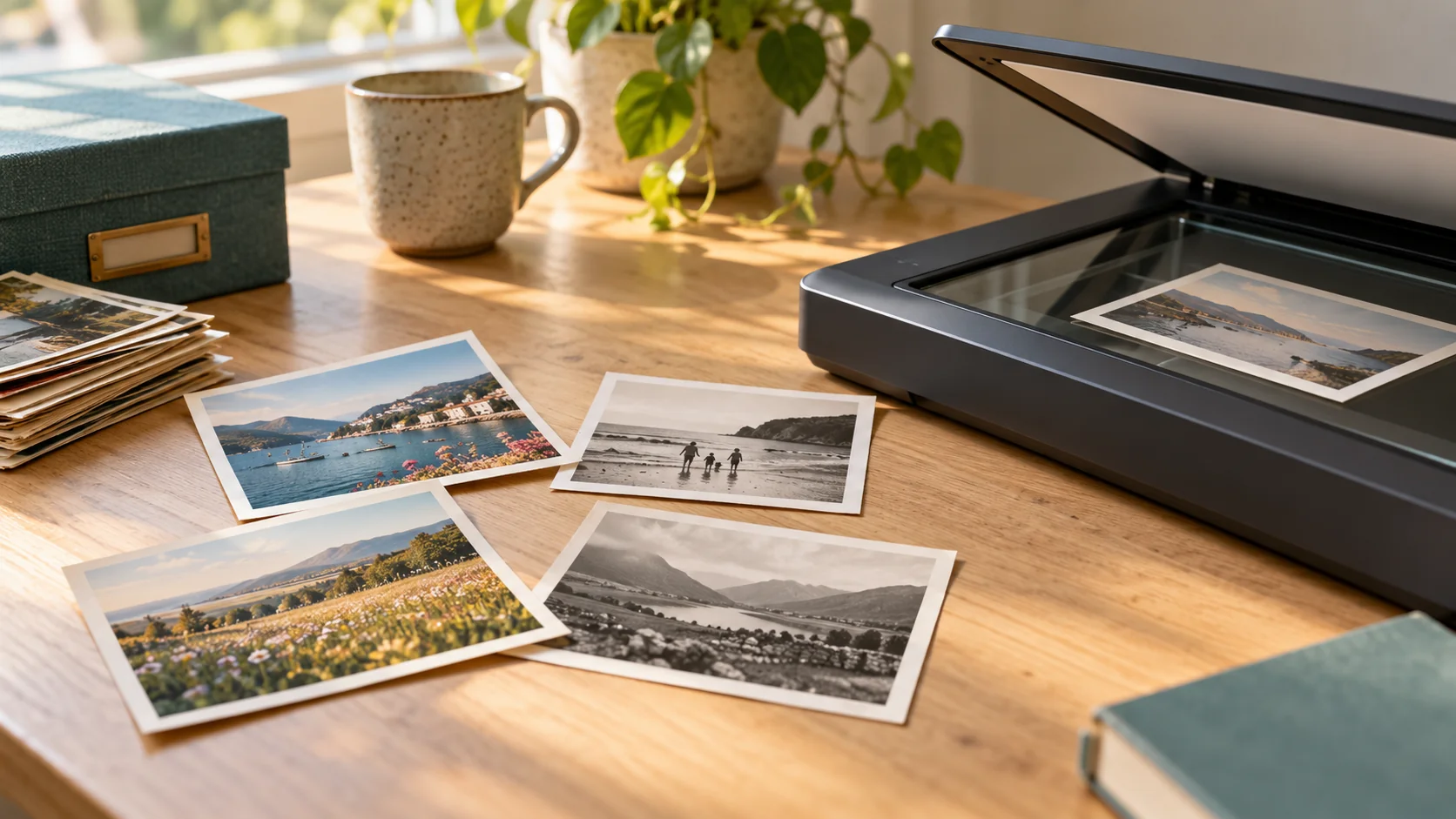
Yes—if the back of a family photograph carries names, dates, places or a personal message, it is worth preserving that information alongside the image. A front-only scan will not capture it. You do not need to digitise every blank reverse, but tell your scanning provider which backs matter and agree the scope and price before work starts.
Which photo backs are worth keeping?
Look for details that explain the picture: a handwritten caption, a studio name, a postcard message or a note identifying someone. An old envelope can also supply context that the photograph alone lacks.
Record what is actually written before trying to interpret it. A date on a processing stamp may not be the day the photograph was taken. Keep an uncertain reading as uncertain—for example, “possibly June 1964”—rather than turning a guess into a firm date.
If relatives can help, ask them to identify people while you can still compare their answers with the original. Keep their later explanation separate from the original inscription.
How can I keep the front and back together digitally?
For your own archive, give each photograph a simple identifier and use it for both sides. For example:
- `family-001-front.jpg`
- `family-001-back.jpg`
These are suggested names for organising your files, not a promised Rewind Digital delivery format. If you want matching filenames or a particular folder arrangement, discuss it when requesting the work.
A short text file can hold a transcription and your own notes. Start the note with the same identifier, then distinguish “written on back” from “identified by a relative”. Keep the original back image too: a transcription may miss handwriting, crossed-out words or other clues.
The Library of Congress recommends descriptive filenames, names and subjects as tags, and a brief description of a photo collection. A small, consistent system is more useful than waiting until you can identify every face.
Should I write new labels on the prints?
Use separate notes or labelled enclosures where possible. The US National Archives advises identifying photographs on their storage enclosures and writing on those enclosures before inserting the prints.
Handle photographs by their edges, support them and avoid bending them. Do not peel off a backing or pull a stuck photograph from an album to reveal its reverse. For attached, curled or fragile material, explain the condition before arranging scanning; specialist conservation advice may be needed.
Is two-sided scanning included in the photo price?
Do not assume it is. Rewind Digital's standard photo scanning service covers loose printed photographs. Capturing backs, transcribing handwriting, albums and restoration need a separate discussion and confirmation; the website's photo count is not an automatic quote for all those extras.
Check the current published prices, then note how many fronts you have and approximately how many backs contain useful information. Say whether you want images of the backs, help preserving their text, or both, so availability and the final quote can be confirmed.
How do I arrange this locally?
Start a photo scanning request and estimate, adding your reverse-side requirements in the notes. Rewind Digital is based in Tadcaster, with drop-off and collection by appointment and return of your originals. Download is included; USB is optional.
Allow up to one week from your agreed drop-off. We'll confirm the completion date with your quote; mention any birthday, anniversary or other deadline when you enquire. Once received, check the digital pairs and keep a separate backup.